Names of notes on the neck
Even though this chart of notes was a pain to make. Don't use it! Move on down the page and learn how to figure out the names of the notes yourself. This chart is just a reference.
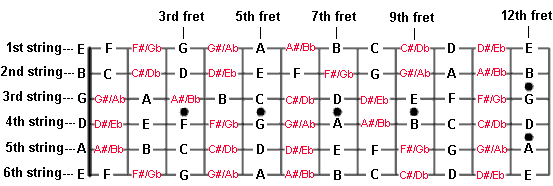
The first thing you should do is learn the names of the notes on the 6th and 5th string. This is because you will need to know the names of these notes to play any movable chords where the root is on the 6th or 5th strings.
The first step is to memorize the following words of wisdom.
All natural notes (A B C D E F G) are a whole step (2 frets) apart, except between E-F and B-C which are a half step (1 fret) apart.
*Although it may seem stupid, make sure you know the 1st 7 letters in the alphabet forwards and backwards. Most people have a little trouble with the backwards part. Once you reach G in the musical alphabet, you start over again with A. (no H's in this universe)
With this information you can find any note on the neck of the guitar, as long as you know the names of the open strings.( 6th=E, 5th=A, 4th=D, 3rd=G, 2nd=B, 1st=E )
Remember that the 1st string is the thinnest string, and the 6th is the thickest.
Notes on the 6th string

The best way to memorize the natural notes on any string is to start out just playing (and naming) a few notes and progressively add 1 note at a time. (e.g. play E F G E G F G A F A B F G B C etc...) If you do this a little each day you can learn the note on the neck quickly. Also notice where the notes are in relation to the fret markers (usually at the frets 3, 5, 7, 9 and 12 also 15, 17, 19, 21). At the 12th fret the note is the same as the open string only sounds higher, this is called an octave. Beyond the 12th fret the names of the notes just repeat. The higher fret markers are equivalent to the lower ones just and octave higher (15=3, 17=5, 19=7, 21=9 )
Notes on the 5th string

Go through the same process as the 6th string. After learning the natural notes on the 5th and 6th string do the same on the 4th, 3rd, and 2nd. The 1st string is the same as the 6th string.
Sharps and Flats
A sharp (#) raises a natural note by a half step (1 fret).
A flat (b) lowers the natural note by a half step.
So between each set of notes ( except between E-F and B-C ) there will be a sharp/flat note. (e.g. the note between F and G is F# or Gb, they are the exact same note just with a different name)
Notes that sound the same but have a different name are called enharmonic.
Another great way to help yourself learn the names of the notes on the neck is to use octave shapes to find the names of the notes on the less familiar strings.
The Practice
Go to this page, and print about 2 billion copies.
Now, every time that you think you don't have anything to do, grab one of the sheets you just printed out and fill in the names of the notes on each neck diagram. It really doesn't matter if you write in the notes one string at a time or across the strings or in any other manner you can come up with. Writing those notes out on the diagrams is gonna help you to start seeing them. That is the whole point of doing the exercise.
Another good practice is to pick a note per day, and for that day, you practice locating that note on your guitar neck. The next day, pick a different note. This exercise can be extended to include practicing chords, scales, modes, arpeggios (you name it) from your selected note.
A third exercise is for when you don't have your guitar near you (maybe you are waiting at the bus stop or riding the subway). Pick a chord or a scale or even a lead lick that you know and visualize exactly where you would play it on the guitar neck. Then try to figure out what notes you would be playing. The more clear you are in your mind about what frets and strings you would be playing, the greater the benefit you will receive from this exercise.
Lastly, anytime while playing the guitar that you can remember to do this, stop and ask yourself what notes you are playing. If you don't know what notes you are playing, figure it out.
There's no real short-cut to learning to see the notes up and down the fingerboard. It simply takes a desire and willingness to learn and practice. It also helps if you can see a potential value in aquiring the skill.